Landlords in England are facing another significant change to the regulation of the private rented sector, with the Government confirming plans for tougher minimum energy efficiency standards.
For some time, landlords have heard references to a 2028 EPC deadline, particularly in relation to new tenancies. However, the Government has now changed course.
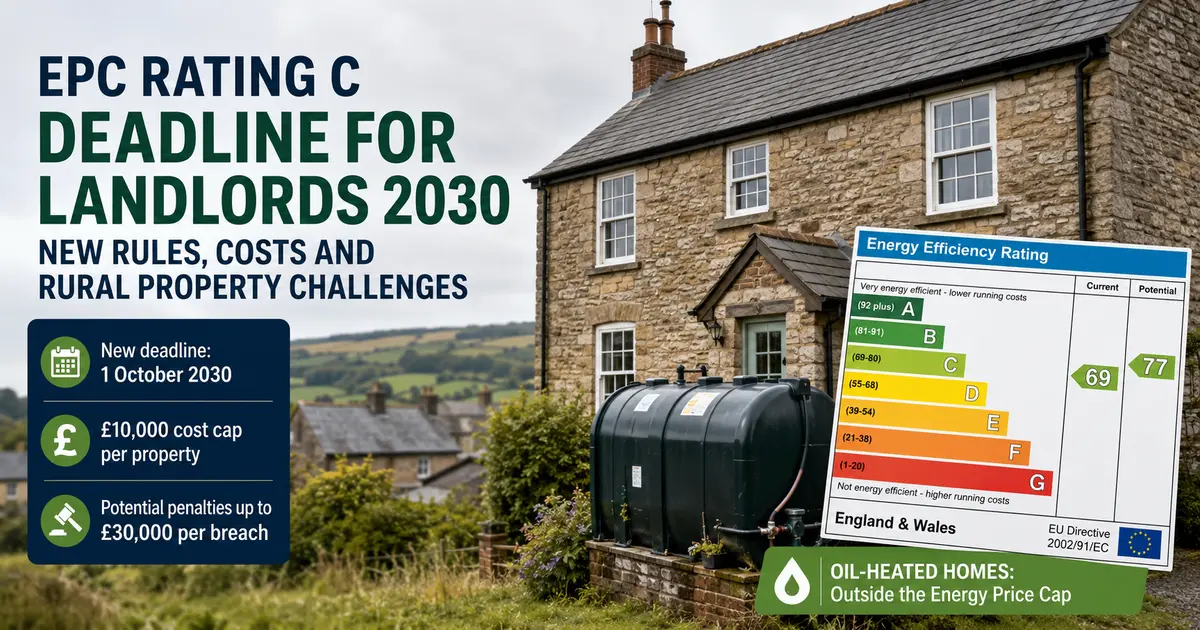
Under its latest plans, the proposed phased implementation has been replaced with a single compliance date of 1 October 2030.
This is particularly important for landlords with older, rural and off-gas-grid properties. Many of these homes are more difficult and expensive to improve and, where they rely on heating oil, their occupants also face energy costs that are not protected by Ofgem’s domestic energy price cap.
The result is an important collision between energy efficiency regulation, the cost of upgrading rural properties and volatile heating costs for tenants.
What has happened to the 2028 EPC deadline?
The Government’s 2025 consultation originally proposed requiring privately rented properties to meet the higher energy efficiency standard for:
new tenancies from 2028; and
all tenancies from 2030.
That is no longer the Government’s final policy.
Following consultation, the Government decided against the two-stage implementation.
Instead, all qualifying privately rented homes will be required to meet the new standard by 1 October 2030, unless the property qualifies for a valid exemption.
This gives landlords additional time, but it should not be interpreted as a reason to postpone planning until 2030.
For properties requiring substantial work, particularly older rural homes, the next few years could be extremely important.
Is the requirement simply “EPC C”?
It is commonly described as an EPC C requirement, but the future regime is more complicated than simply obtaining a C under today’s EPC methodology.
The Government intends to introduce reformed EPCs with new performance metrics.
For private rented properties, the higher minimum standard is expected to consist of:
a fabric performance standard; and
a second standard based on either heating system performance or smart readiness, with the landlord having a choice between the two.
This is important because a property that currently has an EPC D should not necessarily be approached simply by asking: “How do I get this property to a C?”
Landlords should consider the building as a whole: insulation, windows, heat loss, heating system and the improvements that are likely to perform well under the new methodology.
Existing EPC C properties receive important protection
There is particularly useful news for landlords whose properties already achieve EPC C, or which can economically be brought up to C before the new EPC system becomes fully relevant.
Under the Government’s plans, properties with an existing EPC showing an Energy Efficiency Rating of C or above before 1 October 2029 can benefit from transitional “grandparenting”.
That EPC can continue to demonstrate compliance until it expires.
This creates a potentially important planning opportunity for landlords.
Rather than automatically waiting for the new regime, landlords with properties close to today’s EPC C threshold may wish to investigate whether sensible improvements now could achieve a C rating under the existing methodology.
Professional advice should be obtained before committing significant expenditure.
How much could landlords have to spend?
The Government has confirmed a proposed £10,000 cost cap per property.
Broadly, where a landlord cannot achieve the required standard within the applicable cap, an exemption mechanism is intended to be available, subject to the detailed requirements and evidence.
The Government has also proposed an affordability safeguard for lower-value properties, recognising that £10,000 could represent a disproportionate investment in some homes.
The detail matters.
Landlords should not assume that simply spending £10,000 automatically makes a property exempt. The rules are expected to require landlords to undertake qualifying improvements and retain appropriate evidence before relying on an exemption.
Why rural landlords could face a particular challenge
The impact of the new rules will not be evenly distributed across the private rented sector.
A relatively modern flat in an urban area may require comparatively modest improvements.
A detached stone cottage, farmhouse or older rural property may be very different.
Rural properties are more likely to present challenges such as solid walls, older construction methods, limited insulation options, conservation considerations, greater heat loss and lack of access to the mains gas network.
Some are also heated by oil or LPG rather than mains gas.
That introduces another issue which landlords and tenants should understand.
The hidden problem: heating oil is outside the energy price cap
Most households are familiar with Ofgem’s energy price cap.
However, the cap does not protect households using heating oil.
Heating-oil prices are market driven and can change quickly according to international oil prices, supply conditions, location, season and delivery timing.
This can leave tenants in oil-heated rural properties more directly exposed to sudden movements in fuel prices.
The problem is therefore two-sided.
A landlord may own a rural property that is relatively expensive to upgrade to the future energy efficiency standard, while the tenant occupying that same property can face greater exposure to volatile heating costs.
These issues are likely to become increasingly connected as the 2030 deadline approaches.
Why oil-heated properties deserve attention now
For landlords with oil-fired heating, the question should not simply be whether the existing boiler is still operational.
The more useful question is:
What combination of fabric and heating improvements gives this property the most practical route to compliance by 2030?
For some properties, fabric improvements may be the priority.
Depending upon the building, that could include loft insulation, floor insulation, appropriate wall insulation, improved glazing or doors and measures to reduce unnecessary heat loss.
For others, the long-term heating strategy may also need consideration.
The Government’s future EPC methodology is intended to place greater emphasis on the actual characteristics of the building and its heating system rather than relying solely on the current cost-based EPC measure.
Landlords should therefore be cautious about spending substantial sums purely to manipulate today’s EPC score without considering how the property is likely to perform under the future system.
Could heat pumps be part of the answer?
Potentially, but landlords should avoid assuming that every rural property should immediately replace an oil boiler with a heat pump.
The suitability and economics will depend upon the property.
Heat pumps tend to work most effectively when considered alongside the building’s overall heat demand, insulation, emitters and heating design.
There is also Government support available through schemes such as the Boiler Upgrade Scheme, which may make low-carbon heating systems more financially attractive in appropriate properties.
However, landlords should obtain property-specific technical advice before removing a functioning heating system or committing to major expenditure.
The £10,000 cap makes planning particularly important
A rural landlord could easily spend substantial sums on individual improvements without necessarily achieving the required result.
That is why sequencing matters.
For example, spending heavily on a new heating system before investigating the property’s fabric may not represent the best compliance strategy.
Conversely, extensive insulation work may be inappropriate for certain traditional buildings unless it has been properly designed.
Landlords should therefore consider commissioning an energy assessment or retrofit strategy well before the statutory deadline.
What should landlords do between now and 2030?
The British Landlords Association recommends that landlords begin by identifying which properties in their portfolio are most exposed to the new requirements.
Particular attention should be given to properties currently rated EPC D, E, F or G; older and traditionally constructed properties; rural properties; off-gas-grid homes; oil and LPG-heated properties; and properties where significant expenditure may be required.
Landlords should retain invoices, EPCs, assessments and evidence of energy efficiency improvements.
This documentation may become important both for demonstrating compliance and, where appropriate, supporting an exemption.
There is little benefit in panic spending, but equally there is a risk in leaving difficult properties until 2029 or 2030, when demand for assessors, installers and specialist contractors could increase substantially.
Penalties could become much more serious
The Government has also indicated that it intends to strengthen enforcement of the Minimum Energy Efficiency Standards.
Its policy includes seeking powers to increase the maximum financial penalty to £30,000 per property per breach.
That makes the new regime considerably more than an EPC paperwork exercise.
Landlords will need to understand whether their properties comply, what evidence must be retained and whether an exemption has been properly registered where the required standard cannot reasonably be achieved.
A particular warning for rural landlords
Rural landlords should not assume that the delay from the previously proposed 2028 trigger until October 2030 means the issue has disappeared.
In many respects, rural properties are precisely the homes where early planning makes the most sense.
They can be harder to retrofit, may require specialist materials or contractors and may have fewer straightforward heating alternatives.
Where the property is oil heated, tenants can simultaneously be exposed to fuel-price movements because heating oil falls outside Ofgem’s energy price cap.
For those properties, energy affordability and EPC compliance are increasingly becoming two sides of the same problem.
A well-planned improvement programme may therefore achieve more than regulatory compliance. It could reduce the property’s energy demand, make heating costs more manageable for tenants and help protect the property’s long-term viability within the rental market.
BLA recommendation
Landlords do not need to panic about a 2028 EPC C deadline because that is no longer the Government’s chosen implementation timetable.
But neither should landlords wait until 2030.
Our recommendation is to audit portfolios now and identify the difficult properties first.
A landlord with ten properties, for example, should establish which are already comfortably compliant, which could economically achieve today’s EPC C and which present genuine retrofit challenges.
Rural, traditional and oil-heated properties should be near the top of that assessment.
The objective should not simply be to obtain another EPC certificate. It should be to develop a cost-effective route that takes account of the property’s fabric, heating system, future EPC methodology and the £10,000 expenditure cap.
For many landlords, the period between now and October 2030 provides enough time to plan sensibly.
Leaving everything until the final year could prove considerably more expensive.
Important: The future EPC/Minimum Energy Efficiency Standards regime is still dependent on the necessary legislation and detailed regulations being made. Landlords should therefore check the final legislation and Government guidance before carrying out works specifically for regulatory compliance.
Disclaimer: This article is provided for general information and educational purposes only and does not constitute legal, financial, tax, energy-efficiency or property-specific professional advice. Requirements and Government guidance may change. Landlords should obtain appropriate professional advice concerning their individual properties before undertaking significant works or relying upon an exemption.
Useful external links
- GOV.UK – Improving the energy performance of privately rented homes: 2025 update
This is the most important external link because it supports the 1 October 2030 compliance date, future energy-performance standard, £10,000 cost cap and transitional arrangements discussed in your article.
GOV.UK – Improving the energy performance of privately rented homes - GOV.UK – Minimum Energy Efficiency Standards (MEES) landlord guidance
Useful for explaining the existing legal framework, exemptions, enforcement and landlords’ current obligations. The guidance was updated in May 2026.
GOV.UK – Minimum Energy Efficiency Standard: landlord guidance