
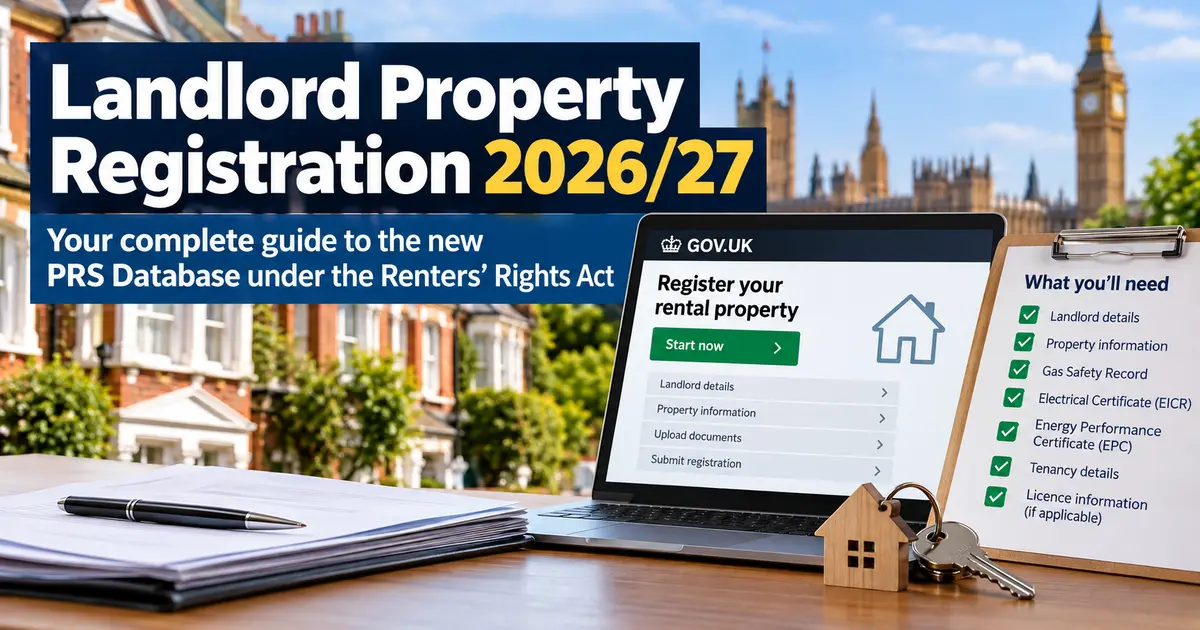
Landlord Property Registration 2026/27: What England Landlords Need to Know
The Government is introducing a new national registration system for private landlords in England under the Renters’ Rights Act 2025. Known as the “Register your rental property” service, it forms part of the new Private Rented Sector Database.
Registration will become a legal requirement for affected landlords, but it is important to understand that not every landlord needs to register on 15 December 2026. The system is being introduced region by region, with landlords generally given a three-month registration window for properties in each region.
Important: The Private Rented Sector Database is provided for under the Renters’ Rights Act 2025. Some of the detailed registration requirements referred to in this guide are contained in the draft Private Rented Sector Database Regulations 2026. These Regulations have not yet been made and may therefore be amended before coming into force.
You do not need to register simply because 15 December 2026 arrives. Your compulsory registration date depends upon where your rental property is situated. The first region is the West Midlands.
What is the new landlord registration system?
The Private Rented Sector Database is being introduced as part of the Renters’ Rights Act reforms. The Government's online service will hold information about landlords, their rental properties and certain property compliance matters.
If you are a landlord of an assured or regulated tenancy covered by the scheme, you will generally need to register yourself and each relevant rental property.
This means that a landlord with several properties will not simply make one registration covering the whole portfolio. Each relevant rental property will require its own property entry.
When do landlords have to register?
The rollout begins on 15 December 2026 and continues across England during 2027.
The deadline is determined by the location of the property, not where the landlord lives or where the landlord's company is registered.
| Region | Registration requirement starts | Deadline to register |
|---|---|---|
| West Midlands | 15 December 2026 | 14 March 2027 |
| East of England | 15 January 2027 | 14 April 2027 |
| East Midlands | 15 February 2027 | 14 May 2027 |
| South East | 15 March 2027 | 14 June 2027 |
| Yorkshire and Humber | 15 April 2027 | 14 July 2027 |
| North West | 15 May 2027 | 14 August 2027 |
| North East | 15 June 2027 | 14 September 2027 |
| London | 15 July 2027 | 14 October 2027 |
| South West | 15 August 2027 | 14 November 2027 |
What do landlords need to do now?
However, landlords should start getting their property and compliance records organised now. This is particularly important for landlords with larger portfolios because each property will require a separate property entry.
Your deadline is based on the rental property's location.
Use the table above and diarise the relevant date.
The Government has confirmed that landlords will need a GOV.UK One Login to use the online registration service.
Landlords with multiple properties should consider preparing a central spreadsheet or property schedule containing the required information.
Make sure gas safety, electrical safety and EPC records are available and current where required.
Do not leave registration until the final few days, particularly if you have a large portfolio.
Can landlords register early?
Yes. The Government has stated that landlords will be able to register properties voluntarily from 15 December 2026, even where the compulsory registration date for that property's region has not yet arrived.
This may be particularly useful for portfolio landlords with properties across several regions. Rather than waiting for several different regional deadlines, a landlord may choose to register properties together once the service is available.
Which properties initially need to be registered?
During the initial rollout, the requirement applies to relevant properties that are currently let or become let during the rollout period.
The Government currently states that unoccupied properties do not initially need to be registered.
The Government intends through future legislation to require relevant unoccupied properties to be registered before they are marketed for letting. Landlords and letting agents will also eventually need to include the relevant landlord and property identifiers in property advertisements. Further guidance is expected before this requirement begins.
What information will landlords need?
The database is much more than a simple list of landlord names and property addresses. Landlords will be required to provide information about themselves and each relevant property.
Landlord information
For individual landlords, required information includes personal and contact details such as the landlord's name, date of birth, residential address, telephone number and email address.
Companies and other organisations will have additional information requirements, which may include the organisation's legal identity and relevant company, charity, partnership, director, trustee or governing body information.
Information about each property
- Property address
- Landlord and correspondence details
- Ownership type
- Type of dwelling
- Number of bedrooms
- Whether the property is currently let
- Relevant freeholder or superior landlord details where applicable
- Property manager details where applicable
- Number of occupants
- Number of households occupying the property
- Relevant HMO, additional or selective licensing information
- Rent charged
- Frequency of rent payments
- Whether utilities are included in the rent
- Which utilities are included
- Whether the property is furnished, partly furnished or unfurnished
What compliance documents will be needed?
The registration system also contains an important health and safety compliance element.
- Gas Safety Record – where the property has a gas supply, including the relevant issue date.
- Electrical safety documentation – the EICR or appropriate Electrical Installation Certificate and relevant dates.
- Energy Performance Certificate (EPC) – where the landlord was required to provide one.
- Expired EPC information – including the tenancy commencement date where relevant.
- MEES exemption information – where the property's energy rating is below the required minimum and an exemption has been registered.
Landlords should therefore use the period before their registration deadline to ensure that their compliance records are organised and readily accessible.
How much will registration cost?
The Government has announced that the registration fee will be £65 for each property, payable annually.
For example, based on the announced £65 annual fee, a landlord registering 10 properties would ordinarily face £650 per year, while a landlord registering 50 properties would ordinarily face £3,250 per year.
The Government has also said that fees will be adjusted or pro-rated during the initial rollout so that landlords who are required to register earlier are not disadvantaged.
Will registration have to be renewed?
Yes. Registration is not a one-off exercise.
Active landlord and dwelling entries are subject to renewal, generally on a 12-month cycle. The relevant fee must be paid for a dwelling entry to be renewed.
Portfolio landlords should therefore consider adding database renewal dates to their existing compliance management systems alongside gas safety, electrical safety, licensing and other property compliance dates.
What happens when information changes?
The database will need to be kept up to date.
The Regulations generally require information or documents in active landlord and dwelling entries to be updated within 28 days where relevant information or documentation becomes out of date.
This makes the database an ongoing compliance obligation rather than simply an annual registration exercise.
For example, landlords should be alert to changes involving property information, tenancy information, occupants, rent, licensing and relevant compliance documents.
How will landlords submit the information?
The Government is introducing a digital “Register your rental property” service. Landlords will need a GOV.UK One Login to use the online service.
An offline registration route will also be available for landlords who cannot use the online service.
Will there be a bulk upload system for portfolio landlords?
This is currently one of the most important unanswered practical questions for landlords with large portfolios.
As at the date of this article, the published Government guidance explains the online registration service but does not currently set out a published technical specification for bulk portfolio submissions or a CSV, XML, JSON or API integration with landlords' property-management systems.
Landlords should therefore not assume that a particular bulk-upload format will be available unless and until the Government publishes further technical guidance.
If you own a substantial number of properties, start compiling the required information now. We would not recommend paying a software developer to build a bespoke Government submission integration until the Government confirms whether an API or bulk-upload facility will be available and publishes the relevant technical specification.
Can a letting agent register for the landlord?
A letting agent or property manager will be able to assist with certain information, but the Government has made clear that the landlord remains responsible.
Landlords will still need to start and end the registration process themselves. They may agree that an appointed letting agent or property manager provides or updates certain property information on their behalf.
Further Government guidance for letting agents and property managers is expected before rollout.
What about landlords with properties in several regions?
Each property's compulsory registration timetable is determined by the region in which that property is situated.
However, the Government has confirmed that landlords can voluntarily register properties before the relevant regional deadline once the service opens.
A portfolio landlord with properties in Birmingham, London and Bristol, for example, could therefore choose to register them together after the service opens rather than operating three entirely separate internal registration exercises.
What happens if a landlord does not register?
Registration will be a legal requirement for landlords within scope.
The Government has confirmed that landlords who fail to register their properties risk enforcement action and financial penalties. Local councils will be able to use information from the database as part of their enforcement activity.
Landlords should therefore treat the registration deadline in the same way as other important statutory property compliance deadlines.
Simple landlord action chart
| Question | What should you do? |
|---|---|
| Do I need to register today? | Generally no. Check the regional timetable for your property. |
| Is 15 December 2026 the deadline for everyone? | No. It is the start of the rollout, beginning with the West Midlands. |
| Do I register myself? | Yes, if you are a landlord within the scope of the scheme. |
| Do I register each property? | Yes. Each relevant rental property requires a property entry. |
| What should I do now? | Prepare your landlord, property, tenancy, licensing and compliance information. |
| Do vacant properties need registering immediately? | Not initially. Future rules will require registration before relevant vacant properties are marketed for letting. |
| How much is it? | £65 per property annually, subject to the Government's rollout arrangements. |
| Can I register early? | Yes. Voluntary early registration will be possible from 15 December 2026. |
| Can my agent help? | Yes, with certain information, but the landlord remains responsible. |
| Do I need a GOV.UK One Login? | Yes, for the online service. |
| Is there a bulk upload/API? | No published technical specification has currently been identified. Further guidance may follow. |
| How often must I renew? | Generally every 12 months. |
| What if information changes? | Relevant information and documents generally need updating within 28 days. |
BLA recommendation for portfolio landlords
Landlords with multiple properties should start preparing now rather than waiting for their regional registration window to open.
We recommend creating a master property schedule containing, for each property:
- full property address;
- property and ownership type;
- number of bedrooms;
- number of occupants and households;
- rent and payment frequency;
- utilities included in the rent;
- furnished status;
- licensing details;
- gas safety details;
- electrical safety details;
- EPC details;
- MEES exemption information where applicable;
- property manager or agent information; and
- relevant document expiry and renewal dates.
This should make the eventual registration process considerably easier and will also provide landlords with a useful central compliance record.
Frequently asked questions
Does this apply throughout the UK?
No. This particular registration service concerns the private rented sector reforms being introduced for England. Landlords in Wales and Scotland operate under different registration and housing regimes.
I live outside England but own an English rental property. Do I need to register?
Potentially yes. The important factor is the property and tenancy falling within the scope of the English scheme, rather than the landlord's home address.
I have 20 properties. Is the fee £65 in total?
No. The announced annual fee is £65 per property. Each relevant property requires its own property entry.
Do I have to upload my certificates?
The information requirements include relevant gas safety, electrical safety and EPC documentation or information where applicable. Landlords should therefore have these records ready before registration.
Will tenants be able to see the database?
The Government intends that tenants will eventually be able to use the service to check certain information about landlords and properties. Further guidance is expected on exactly what information will be publicly accessible.
Should I register before my deadline?
You do not have to register before your applicable deadline, but early voluntary registration may be convenient, particularly for landlords with properties across several regions.
What should landlords do next?
Do not panic and do not assume that every landlord must register on 15 December 2026. Check the region in which each property is located, identify the relevant deadline, and start organising the information and compliance documents required for each property.
Landlords with larger portfolios should begin this exercise early because each relevant property requires its own entry and the database will create an ongoing obligation to keep information up to date.
Keep up to date with the Renters’ Rights Act
The British Landlords Association will continue to monitor the rollout of the Private Rented Sector Database and update members when further Government guidance, agent procedures or technical submission arrangements are published.
British Landlords Association Landlord Documents Landlord Training CoursesOfficial sources and further reading
Landlords can also consult the Government's “Register your rental property” guidance and the Private Rented Sector Database Regulations 2026 for the detailed statutory requirements.
Article reviewed: 5 October 2026. Government guidance may be updated as the registration service approaches launch. BLA members should check for subsequent updates before taking action.
Disclaimer: This article provides general information for landlords in England and is not intended to constitute legal advice. The application of the Renters’ Rights Act 2025 and the Private Rented Sector Database requirements will depend upon the circumstances of the landlord, property and tenancy. Government guidance and secondary legislation may also be amended or supplemented. Landlords should check the current requirements applicable to their properties and obtain appropriate professional advice where necessary.