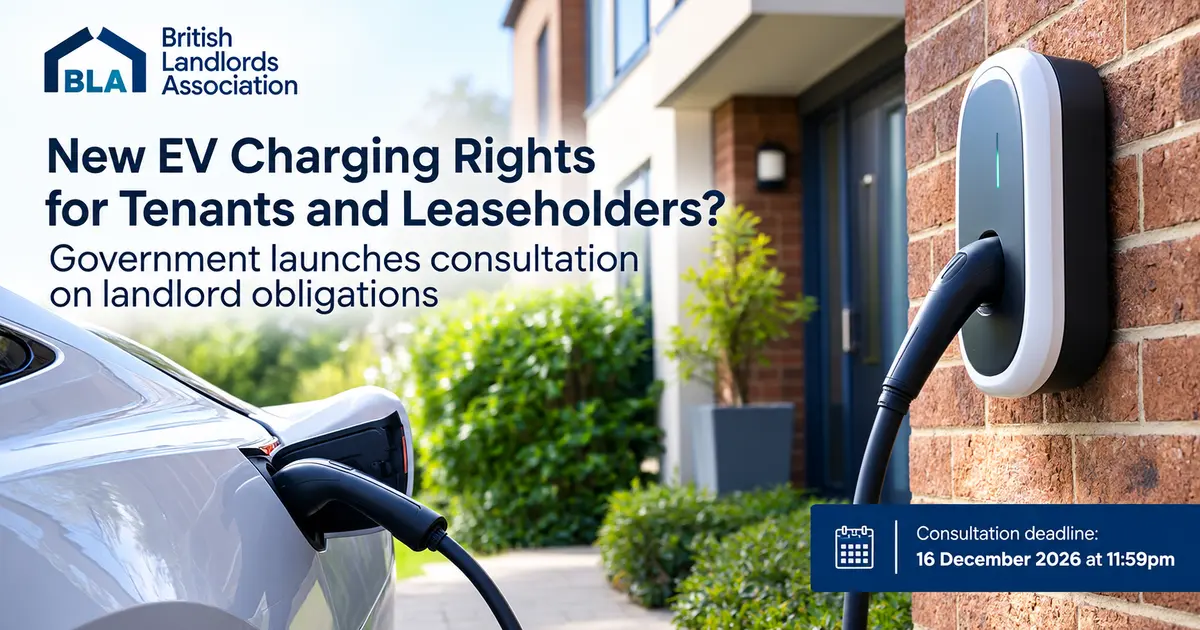
New EV Charging Rights for Tenants and Leaseholders? Government Launches Consultation on Landlord Obligations
Published: 21 October 2026
Important update for residential landlords, freeholders, leaseholders and managing agents in England.
The UK Government has launched two consultations that could lead to significant changes to electric vehicle (EV) charging arrangements at residential rental properties and leasehold developments in England.
The proposals, announced by the Office for Zero Emission Vehicles, include potentially introducing a new "ability to charge" for residential tenants and leaseholders.
If introduced through legislation, this could make it easier for tenants and leaseholders to obtain permission to install EV charging points and place additional responsibilities on landlords and freeholders when considering requests.
The Government is also considering amendments to Building Regulations Part S, including extending EV charging infrastructure requirements to covered car parks.
Important for landlords: These proposals are currently subject to Government consultation. They are not new statutory obligations currently in force.
Consultation deadline: 16 December 2026 at 11:59pm.
What Is the Proposed "Ability to Charge"?
The Government is examining whether residential tenants and leaseholders should have a clearer process for obtaining permission to install EV charging points at properties with off-street parking.
Currently, tenants and leaseholders may need permission from their landlord, freeholder or managing agent before installing charging equipment.
The Government is considering two possible approaches.
Option 1: Non-Statutory Guidance
The Government could introduce guidance explaining how tenants and leaseholders should request permission and how landlords should assess applications.
This approach would not itself introduce a new statutory obligation to grant permission.
Option 2: New Legislation
The Government is also considering a statutory framework that could require landlords and freeholders to:
- Consider EV charging installation requests within a specified timeframe.
- Provide timely written decisions.
- Avoid unreasonably refusing permission.
- Explain the reasons for refusing an application.
- Follow a clearer procedure for resolving disagreements.
The consultation considers a possible 28-calendar-day response period, although no final statutory deadline has been established.
Any new statutory rights would depend on future legislation.
Would Landlords Have to Pay for EV Charging Points?
One of the most important questions for residential landlords is who would be responsible for the installation and ongoing costs.
Under the proposed approach, tenants and leaseholders would generally be expected to arrange and fund the initial installation, including relevant permission costs.
However, the Government is seeking views on responsibility for:
- EV charging point installation costs.
- Electrical infrastructure and network upgrades.
- Maintenance and repairs.
- Electricity consumption and billing.
- Removal of equipment when a tenancy ends.
- Reinstatement of affected areas.
- Insurance and ongoing safety responsibilities.
These matters have not yet been finalised.
The British Landlords Association considers it important that any future framework clearly identifies financial responsibilities and provides appropriate safeguards against unexpected liabilities for property owners.
Can Landlords Refuse Permission to Install an EV Charger?
The proposed framework would not necessarily give tenants an unrestricted right to install charging equipment.
The Government is considering circumstances in which landlords and freeholders could reasonably refuse permission.
Potential considerations include:
- Restrictions under existing leases or other legal obligations.
- Whether suitable off-street parking is available.
- Electrical capacity and infrastructure limitations.
- Significant network upgrade requirements.
- Electrical and building safety concerns.
- Parking capacity and the rights of other residents.
- Existing or planned communal charging infrastructure.
The precise grounds for refusal would depend on the final Government proposals and any legislation subsequently introduced.
Landlords should continue to consider safety, insurance, lease restrictions and any necessary third-party permissions before authorising electrical installations.
What About Leasehold Flats and Communal Parking?
The proposed changes could be particularly relevant to blocks of flats and developments with shared parking facilities.
Many leaseholders and tenants do not have direct control over communal parking areas or shared electrical infrastructure.
Installing an EV charging point may therefore require permission from a freeholder, management company or managing agent.
The consultation considers how a clearer permissions process could operate where parking spaces are allocated, demised or subject to shared management arrangements.
Important considerations include:
- Responsibility for shared electrical infrastructure.
- Whether individual installations could affect other residents.
- Management of communal parking spaces.
- Installation and maintenance costs.
- Building safety and insurance requirements.
Freeholders and managing agents should pay particular attention to these proposals because they may affect how future requests for EV charging installations are managed.
Proposed Changes to Building Regulations Part S
Alongside the proposed charging permissions framework, the Government has launched a separate consultation concerning Building Regulations Part S.
Part S sets out EV charging infrastructure requirements for relevant new buildings and buildings undergoing major renovation in England.
The Government is considering three principal areas of change.
1. Extending Requirements to Covered Car Parks
The Government is considering extending EV charging requirements to certain covered car parks, including enclosed and open-sided structures that are currently outside relevant requirements.
This could affect developers and landlords undertaking qualifying construction or renovation projects.
2. Reviewing the £3,600 Installation Cost Cap
The Government is examining whether the existing £3,600 installation cost cap should be adjusted to reflect inflation since 2021.
This does not mean that every existing landlord would be required to spend £3,600 installing an EV charger.
The consultation concerns the operation of the cost cap within the Building Regulations framework.
3. Wider Amendments to Part S
The Government is also inviting views on further technical and regulatory amendments.
Any changes would depend on the consultation outcome and the subsequent regulatory process.
Do Existing Landlords Need to Install EV Chargers Now?
No new general requirement to install EV charging points at existing rental properties arises from these consultations.
Landlords should distinguish between existing Building Regulations obligations and the Government's proposed new permissions framework for tenants and leaseholders.
There is currently no automatic requirement under these proposals for every existing rental property to have an EV charging point.
However, existing legal obligations may apply to certain new developments, building conversions and major renovation projects.
Existing tenancy agreements, lease provisions, consent requirements and applicable electrical safety regulations also remain relevant.
What Should Landlords Do Now?
Although the proposed changes are not yet law, landlords and managing agents may wish to prepare for possible future requirements.
The British Landlords Association suggests that members consider the following:
- Review tenancy agreements: Check existing provisions concerning alterations, electrical installations and landlord consent.
- Review leasehold restrictions: Establish whether freeholder or management company approval is required.
- Introduce a written request procedure: Keep clear records of requests and decisions.
- Check electrical suitability: Obtain professional advice before approving charging equipment.
- Clarify financial responsibilities: Consider installation, maintenance, electricity costs and reinstatement.
- Review insurance implications: Check whether insurers impose conditions relating to EV charging equipment.
- Monitor legislative developments: Follow the consultation outcome and any subsequent changes to the law.
Landlords should not assume that tenants can install EV charging equipment without obtaining the necessary permissions.
When Could the New Law Come Into Force?
The Government has not confirmed an implementation date for the proposed statutory "ability to charge".
Both consultations close on 16 December 2026 at 11:59pm.
Following the consultation period, the Government will consider the responses and determine whether to introduce legislation, guidance or other regulatory changes.
Until further decisions are announced, landlords should treat these measures as proposed reforms rather than existing legal obligations.
Have Your Say Before 16 December 2026
The Government is inviting views from landlords, freeholders, leaseholders, tenants, managing agents, developers and other interested parties.
Landlords may wish to comment on installation costs, safety responsibilities, reasonable grounds for refusal, response times and the practical management of communal parking.
The British Landlords Association encourages members to familiarise themselves with the proposals and consider their potential implications for residential property management.
British Landlords Association – Keeping Members Informed
The British Landlords Association continues to monitor legislative and regulatory developments affecting residential and commercial property owners across England, Wales and Scotland.
We will provide further updates when the Government publishes its consultation responses or confirms any legislative changes.
Landlords seeking guidance on tenancy agreements, legal responsibilities and property management can access support through BLA membership.
Join the British Landlords Association
Official Government Consultations – Further Reading
For further information and to participate in the consultations, visit the following official GOV.UK resources:
-
Expanding Electric Vehicle Charging Access for Tenants and Leaseholders
Government consultation examining the proposed "ability to charge" and the permissions process for residential tenants and leaseholders.
Read the official GOV.UK consultation -
Amending the Building Regulations: Electric Vehicle Charging Infrastructure
Government consultation concerning proposed amendments to Part S, including covered car parks and installation cost caps.
Read the official GOV.UK consultation
Consultation closing date: 16 December 2026 at 11:59pm.
Legal Disclaimer: This article is provided by the British Landlords Association for general information purposes only. It discusses Government proposals subject to consultation and does not constitute legal advice. The proposals are not enacted legislation and may be amended or withdrawn. Existing obligations depend on the individual circumstances of the property and applicable legislation. Landlords should seek appropriate professional advice where necessary.