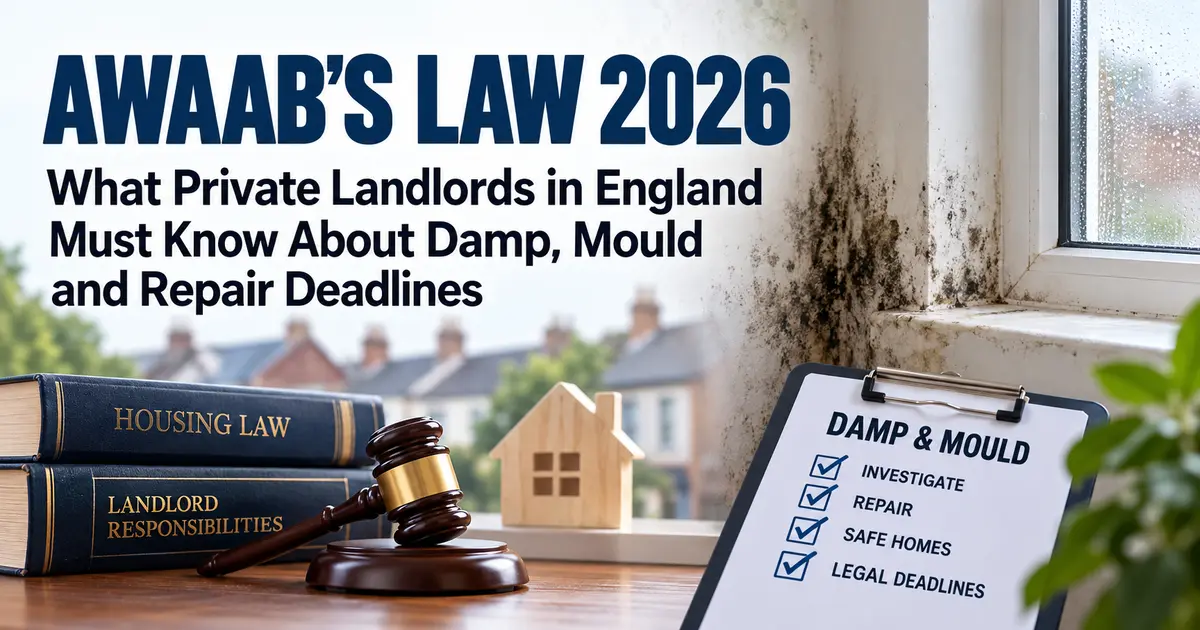
Awaab's Law 2026: What Private Landlords in England Must Know About Damp, Mould and Repair Deadlines
Updated: 12 October 2026 | British Landlords Association | England
Awaab's Law represents a major development in housing safety legislation in England. It introduces legally enforceable deadlines for social housing landlords to investigate and address serious hazards, particularly damp and mould. The government is now consulting on extending similar requirements to private residential landlords.
Following the Renters' Rights Act 2025, private landlords, letting agents and property managers should familiarise themselves with the proposed requirements and prepare for additional responsibilities concerning the safety and condition of rented homes.
Important legal update – October 2026: Awaab's Law came into force for social housing landlords in England on 27 October 2025. Its specific statutory deadlines do not yet apply to ordinary private residential landlords.
On 9 October 2026, the government opened a consultation on extending Awaab's Law to private rented tenancies and certain accommodation occupied under licence. The consultation closes on 18 December 2026.
The government identifies 2027 as the earliest feasible implementation year for private rented tenancies, but no commencement date has been confirmed.
What Is Awaab's Law?
Awaab's Law is the commonly used name for legislation requiring landlords within its scope to investigate and address prescribed housing hazards within legally defined timescales.
It is named after Awaab Ishak, a two-year-old child who died in December 2020 following prolonged exposure to mould in his family's social housing flat in Rochdale, Greater Manchester.
His death highlighted serious failures in the way housing complaints were investigated and addressed. The legislation aims to prevent similar tragedies by requiring landlords to respond promptly to dangerous housing conditions.
Awaab's Law was introduced for social housing through the Social Housing (Regulation) Act 2023 and implemented through the Hazards in Social Housing (Prescribed Requirements) (England) Regulations 2025.
Its central requirements include:
- Investigating potential prescribed hazards within statutory timescales.
- Completing relevant safety works within the applicable deadlines.
- Providing written investigation findings where required.
- Arranging further preventative works to reduce the risk of hazards recurring.
- Providing suitable alternative accommodation where legally required.
- Keeping tenants informed about investigations and necessary repairs.
Does Awaab's Law Apply to Private Landlords in England?
As at 12 October 2026, the specific Awaab's Law repair deadlines do not yet apply to ordinary private residential landlords in England.
The existing regulations apply to relevant social housing tenancies, including accommodation provided by registered social landlords.
However, sections 60 and 61 of the Renters' Rights Act 2025 provide powers to extend Awaab's Law requirements to private rented tenancies and specified accommodation occupied under licence.
Further regulations are necessary to establish the precise obligations, including the hazards covered, investigation periods and deadlines for completing safety works.
The government is considering how the social housing framework should be adapted to the private rented sector, recognising differences between large social housing providers and individual private landlords.
Until the new regulations commence, private landlords must continue to comply with their existing statutory repairing, housing safety and fitness for human habitation obligations.
When Will Awaab's Law Apply to Private Landlords?
The government's October 2026 consultation states that 2027 is the earliest feasible implementation year for extending Awaab's Law to private rented tenancies.
However, 2027 is not a confirmed commencement date.
The consultation seeks views on implementation in 2027, 2028, 2029 or another appropriate period.
The government must consider consultation responses, prepare the necessary regulations and allow landlords and letting agents sufficient time to establish suitable procedures.
Accordingly, private landlords should not assume that the legislation will automatically commence in 2027 or that the social housing deadlines will be adopted without modification.
Awaab's Law Repair Deadlines: What Are the Current Rules?
The following deadlines apply under the current social housing framework. They are provided to explain the existing law and should not be treated as confirmed deadlines for private landlords.
| Requirement | Current social housing deadline |
|---|---|
| Emergency hazards | Investigate and complete relevant emergency safety work as soon as reasonably practicable, within 24 hours of becoming aware of the potential hazard. |
| Significant damp and mould hazards | Investigate within 10 working days of becoming aware of the potential significant hazard. |
| Written investigation summary | Provide within 3 working days after the investigation concludes, where required by the regulations. |
| Relevant safety works | Complete within 5 working days after the investigation concludes where a significant hazard is identified. |
| Supplementary preventative works | Begin, or take steps to begin, within 5 working days after the investigation concludes. |
| Where preventative works cannot begin immediately | Take the required steps promptly so works begin as soon as reasonably practicable and physically commence within the applicable 12-week backstop. |
| Alternative accommodation | Secure suitable alternative accommodation at the landlord's expense where the regulations require it because the necessary safety works cannot be completed within the applicable period. |
Important Distinction: Making a Property Safe and Completing Permanent Repairs
The five-working-day requirement for significant hazards concerns completion of the relevant safety works needed to address the identified danger.
It does not necessarily require every permanent or preventative repair to be completed within five working days.
For example, a landlord may need to take immediate action to remove dangerous mould and make an affected room safe, while arranging more extensive building work to remedy the underlying cause.
However, temporary treatment alone will not necessarily satisfy the law if the hazard remains unsafe.
Further preventative works must be undertaken in accordance with the separate statutory requirements.
What Does the 12-Week Deadline Mean?
The 12-week backstop relates to the physical commencement of relevant supplementary preventative works, not necessarily completion of every permanent repair.
Where work cannot reasonably begin within five working days, the landlord must take the required steps to arrange its commencement as soon as reasonably practicable.
The statutory framework requires relevant supplementary preventative works to physically begin within 12 weeks at the latest.
This does not give landlords an automatic right to wait 12 weeks before acting. Urgent safety work remains subject to the shorter deadlines.
Landlords must also comply with other applicable repairing and safety obligations.
What Hazards Does Awaab's Law Cover?
Damp and Mould
The first phase of Awaab's Law addresses significant damp and mould hazards in social housing.
Common underlying causes include:
- Leaking roofs, gutters and external walls.
- Defective plumbing and water penetration.
- Inadequate ventilation.
- Insufficient insulation and thermal bridging.
- Persistent condensation.
- Inadequate or defective heating systems.
- Structural defects allowing moisture to enter the property.
Exposure to mould may aggravate asthma, respiratory illnesses and allergies. Young children, older people and residents with existing health conditions may be particularly vulnerable.
Landlords should investigate the underlying cause rather than simply removing visible mould or painting over affected surfaces.
Emergency Hazards
Emergency hazards are those presenting an imminent and significant risk of harm.
Depending on the circumstances, examples may include dangerous electrical installations, serious structural instability, major leaks and other immediately dangerous conditions.
The legal classification depends on the severity of the hazard and the risk to occupants.
Additional Housing Hazards
The second phase of Awaab's Law for social housing is scheduled to commence on 30 November 2026, subject to parliamentary approval.
This phase is intended to extend the requirements to additional significant hazards, including:
- Excess cold and excess heat.
- Fire and explosion hazards.
- Electrical hazards.
- Falls on level surfaces and stairs.
- Falls between levels.
- Structural collapse and falling building elements.
- Domestic hygiene hazards.
A further phase is planned for 2027, covering additional prescribed hazards. Overcrowding is not included within the planned phased Awaab's Law hazard coverage.
Awaab's Law Statistics: Damp, Mould and Housing Conditions in England
The English Housing Survey 2024–25 provides evidence of the extent of poor housing conditions across England.
The following figures relate to households living in properties with surveyor-assessed conditions, rather than simply households reporting problems themselves.
Source: Ministry of Housing, Communities and Local Government, English Housing Survey 2024–25. Figures are rounded.
Damp Problems Across Housing Tenures
The survey found that damp problems were more prevalent in the private rented sector than in owner-occupied homes.
| Housing tenure | Homes affected by damp |
|---|---|
| Private rented sector | 11% |
| Local authority housing | 9% |
| Housing association properties | 6% |
| Owner-occupied homes | 4% |
Approximately 6% of households in England lived in properties with surveyor-assessed damp problems.
These figures highlight the importance of preventative maintenance, adequate ventilation, effective heating and prompt repairs.
What Existing Laws Must Private Landlords Comply With?
Although the specific Awaab's Law deadlines have not yet been extended to private landlords, several existing laws already regulate the condition and safety of rented properties.
Landlord and Tenant Act 1985
Section 11 generally requires landlords of qualifying residential tenancies to keep the structure and exterior of the property in repair.
This includes roofs, external walls, gutters, drains and relevant installations for water, gas, electricity, sanitation, space heating and water heating.
Landlords must generally carry out repairs within a reasonable period after becoming aware of the problem, taking account of the nature and urgency of the defect.
Homes (Fitness for Human Habitation) Act 2018
The Homes (Fitness for Human Habitation) Act 2018 introduced provisions into the Landlord and Tenant Act 1985 requiring qualifying rented accommodation to be fit for human habitation at the beginning of the tenancy and throughout its duration.
Serious damp, mould, inadequate ventilation, excess cold and other hazards may render a property unfit for human habitation.
Tenants may bring civil proceedings where the relevant statutory obligations have been breached.
Housing Act 2004 and HHSRS
The Housing Health and Safety Rating System, commonly known as HHSRS, is used by local authorities to assess risks arising from housing hazards.
Hazards are classified as Category 1 or Category 2.
Category 1 hazards are the most serious and trigger a duty on local authorities to take appropriate enforcement action under the statutory framework.
Depending on the circumstances, councils may serve improvement notices, make prohibition orders or take emergency enforcement action.
Can Landlords Blame Tenants for Condensation and Mould?
Disputes frequently arise over whether mould results from defects in a property or the way occupants use the accommodation.
Some landlords argue that condensation is caused by tenants failing to ventilate rooms, drying clothes indoors or not using heating adequately.
Although occupant behaviour can contribute to condensation, landlords should not automatically conclude that the tenant is responsible.
Mould may also arise from poor insulation, inadequate ventilation, defective windows, thermal bridging, faulty heating systems, water leaks and structural defects.
Landlords should arrange an appropriate inspection, identify the underlying causes and determine what remedial works are legally required.
Where tenant behaviour is considered a contributing factor, this should be supported by appropriate evidence rather than assumption.
Providing practical guidance about heating and ventilation may be helpful, but it does not replace the landlord's obligation to address defects or conditions for which the landlord is legally responsible.
What Happens if a Landlord Fails to Comply?
Failure to comply with existing housing safety and repair legislation can result in serious legal and financial consequences.
Depending on the circumstances and applicable legislation, landlords may face:
- Local authority enforcement action.
- Statutory improvement notices.
- Financial penalties where authorised by law.
- Criminal prosecution for relevant offences.
- Civil claims for disrepair or unfitness for human habitation.
- Court orders requiring remedial works.
- Compensation claims from tenants.
- Legal costs and additional property management expenses.
Can Private Landlords Face Financial Penalties of Up to £7,000?
Existing housing enforcement legislation, including provisions introduced or amended by the Renters' Rights Act 2025, allows financial penalties in specified circumstances.
Financial penalties of up to £7,000 may be available for certain breaches under the relevant statutory provisions, but this is not a universal penalty for every instance of damp, mould or delayed repairs.
The applicable penalty depends on the particular offence or breach, the legislation under which enforcement is taken and the circumstances of the case.
These existing enforcement provisions should not be confused with the proposed extension of Awaab's Law to private landlords.
As at October 2026, private landlords are not subject to a new automatic Awaab's Law financial penalty simply because they fail to meet the social housing repair deadlines.
In social housing, Awaab's Law obligations are enforceable through the courts, and serious failures may also attract regulatory scrutiny.
The detailed enforcement arrangements for the private rented sector extension remain subject to the final legislative framework.
How Should Private Landlords Prepare for Awaab's Law?
Introduce a Formal Repairs Reporting Procedure
Tenants should have a straightforward method of reporting damp, mould, leaks, electrical concerns and other hazards.
Landlords should record when complaints are received, the nature of the problem and the action taken.
Prioritise Serious Safety Hazards
Potentially dangerous conditions should be assessed promptly.
Gas leaks, dangerous electrical installations and serious structural hazards may require immediate intervention by appropriately qualified professionals.
Conduct Regular Property Inspections
Periodic inspections can help identify maintenance problems before they become serious.
Landlords must arrange inspections in accordance with applicable legal requirements, including appropriate notice and respect for the tenant's right to quiet enjoyment.
Use Competent Contractors
Landlords should instruct suitably qualified professionals to investigate and remedy technical defects.
Independent damp surveys, electrical inspections or structural reports may be necessary where the cause of a problem is uncertain or disputed.
Maintain Comprehensive Records
Landlords should retain:
- Tenant complaints and correspondence.
- Inspection reports and photographs.
- Contractor instructions and quotations.
- Invoices and completion certificates.
- Records of attempted access.
- Evidence of completed repairs.
- Follow-up communications with tenants.
Accurate records can provide important evidence if a dispute is subsequently investigated by a local authority or considered by a court.
Consider Vulnerable Occupants
The seriousness of a hazard may depend partly on the people exposed to it.
Children, older residents and people with certain respiratory or other health conditions may be more vulnerable to damp, mould and excess cold.
Landlords should consider relevant vulnerabilities when assessing urgency and should handle personal information appropriately.
Review Letting Agent Management Agreements
Where a letting agent manages repairs, landlords should review the agent's authority, reporting arrangements and emergency procedures.
The government's consultation explains that Awaab's Law would operate as an implied tenancy term, with landlords remaining ultimately liable for the relevant duties even where agents manage repairs.
Landlords should therefore ensure that their management agreements and contractor arrangements allow them to meet future statutory deadlines.
Review Landlord Insurance
Landlords should review buildings insurance, property owners' liability insurance and legal expenses cover.
Insurance does not replace statutory compliance, and gradual deterioration or maintenance-related mould damage may be excluded from cover.
Government Consultation: Extending Awaab's Law to Private Landlords
On 9 October 2026, the government opened a consultation on extending Awaab's Law to private rented tenancies and certain accommodation occupied under licence.
The consultation examines how legally prescribed investigation and repair deadlines should operate within the private rented sector.
Important considerations include:
- The types of hazards that should be covered.
- The timescales for investigating serious hazards.
- The deadlines for completing relevant safety works.
- How emergency hazards should be addressed.
- The availability of suitably qualified contractors.
- The financial and practical impact on private landlords.
- Arrangements where access to a property is refused.
- The circumstances requiring alternative accommodation.
- The application of the legislation to licensed accommodation.
- The appropriate implementation date and any phased introduction.
The consultation closes on 18 December 2026.
The British Landlords Association encourages landlords and letting agents to review the proposals and consider submitting their views.
Frequently Asked Questions About Awaab's Law
When did Awaab's Law come into force?
Awaab's Law came into force for social housing landlords in England on 27 October 2025. The initial phase covers significant damp and mould hazards and all emergency hazards.
Does Awaab's Law apply to private landlords?
As at October 2026, the specific statutory deadlines do not yet apply to ordinary private residential landlords. The government is consulting on extending the requirements to the private rented sector.
When will Awaab's Law apply to private landlords?
The government identifies 2027 as the earliest feasible implementation year. However, no commencement date has been confirmed. The consultation considers implementation in 2027, 2028, 2029 or another appropriate period.
Do landlords have 14 days to fix mould?
There is no universal 14-day rule. Under current social housing requirements, significant damp and mould hazards must generally be investigated within 10 working days and relevant safety works completed within 5 working days after the investigation. Emergency hazards are subject to a 24-hour deadline.
Does the five-working-day deadline mean all repairs must be completed?
No. The deadline concerns relevant safety works necessary to address the significant hazard. Further preventative works may be required to address the underlying cause and prevent recurrence, subject to separate statutory requirements.
Does the 12-week deadline mean landlords can wait 12 weeks?
No. The 12-week period is a backstop for physically commencing relevant supplementary preventative works. Landlords must act as soon as reasonably practicable and meet the separate deadlines for urgent safety work.
What happens if a tenant refuses access for repairs?
Landlords should document reasonable attempts to arrange access, explain the urgency and offer suitable appointments. Refusal does not automatically permit forced entry. Legal advice may be necessary where access remains disputed.
Does Awaab's Law apply to HMOs?
Private HMOs are not yet subject to the proposed private sector Awaab's Law deadlines. However, HMO landlords already have important statutory safety, management and licensing obligations where applicable. The future position will depend on the final regulations.
Can tenants withhold rent because of mould?
Tenants should not assume that damp or mould automatically entitles them to stop paying rent. Rent generally remains payable unless there is a lawful basis or agreement. Separate remedies may be available for disrepair.
Can landlords increase rent to pay for repairs?
Awaab's Law does not itself provide an additional right to increase rent. Any rent increase must comply with the applicable tenancy legislation and statutory procedures.
Does Awaab's Law apply in Wales?
The English Awaab's Law framework does not automatically apply in Wales. Welsh landlords are subject to separate housing legislation, including the Renting Homes (Wales) Act 2016 and relevant fitness for human habitation requirements.
Does Awaab's Law apply in Scotland?
The English legislation does not automatically apply in Scotland. Scottish landlords must comply with the repairing standard, tolerable standard and other applicable housing safety legislation.
What if a contractor cannot complete repairs within the deadline?
Under the current social housing framework, landlords must comply with the applicable safety and accommodation requirements. Contractor shortages do not automatically remove legal responsibilities. The detailed private sector arrangements remain under consultation.
Can tenants sue landlords for mould?
Yes. Where the legal requirements are satisfied, tenants may bring claims for disrepair or breach of the obligation to provide accommodation fit for human habitation. Remedies may include damages and orders requiring repairs.
Are landlords responsible for mould caused by tenants?
Responsibility depends on the cause of the mould and the relevant legal obligations. Landlords should investigate the circumstances rather than automatically attributing mould to tenant behaviour.
Will landlords have to provide alternative accommodation?
Current social housing regulations require suitable alternative accommodation in specified circumstances where safety work cannot be completed within the statutory period. The equivalent private sector requirements have not yet been finalised.
Can private landlords be fined £7,000 for mould?
Financial penalties of up to £7,000 may apply to certain breaches under existing housing enforcement provisions, but not automatically to every mould complaint. The precise legal basis and circumstances must be considered. These penalties should not be confused with future private sector Awaab's Law requirements.
Does landlord insurance cover mould damage?
Cover depends on the insurance policy and the cause of the damage. Gradual deterioration, condensation and maintenance-related issues are frequently excluded.
How can landlords prove they acted responsibly?
Landlords should maintain accurate records of complaints, inspections, contractor appointments, repairs, photographs and communications with tenants. Such records can be important evidence in legal or enforcement proceedings.
Three Official Government Resources to Read More
1. Government Consultation on Extending Awaab's Law
Read the government's October 2026 proposals for extending Awaab's Law to private rented tenancies and certain licensed accommodation.
Read Consultation2. Awaab's Law: Official Guidance for Social Landlords
Government guidance explaining the current statutory repair deadlines, investigations, safety works and preventative repair requirements.
Read Government Guidance3. English Housing Survey 2024–25
Official government research and statistics concerning housing quality, damp, mould and housing hazards in England.
View Housing StatisticsConclusion: What Awaab's Law Means for Private Landlords
Awaab's Law represents an important development in the regulation of serious housing hazards in England.
Although its specific statutory deadlines currently apply to social housing landlords, the government's October 2026 consultation is a significant step towards extending similar requirements to the private rented sector.
The earliest feasible implementation year identified by the government is 2027, but the final commencement date and detailed private sector requirements remain subject to consultation and further regulations.
Private landlords should prepare by maintaining safe accommodation, responding promptly to repair complaints, investigating damp and mould thoroughly and retaining comprehensive maintenance records.
Landlords should also review their arrangements with letting agents and contractors to ensure that serious hazards can be addressed promptly.
The British Landlords Association will continue to monitor developments and provide guidance to members as the legislation progresses.
Landlord Advice, Documents and Membership
The British Landlords Association provides landlord guidance, legal documents, training and membership services to residential and commercial landlords across England, Wales and Scotland.
Join our landlord community and access guidance on housing legislation, property management and landlord responsibilities.
Join the British Landlords Association Visit the BLA WebsiteLegal Disclaimer: This article provides general information about housing legislation in England as at 12 October 2026. It does not constitute legal advice. The requirements concerning the extension of Awaab's Law to private landlords may change following consultation, regulations and government announcements. Landlords should obtain professional legal advice concerning their particular circumstances.