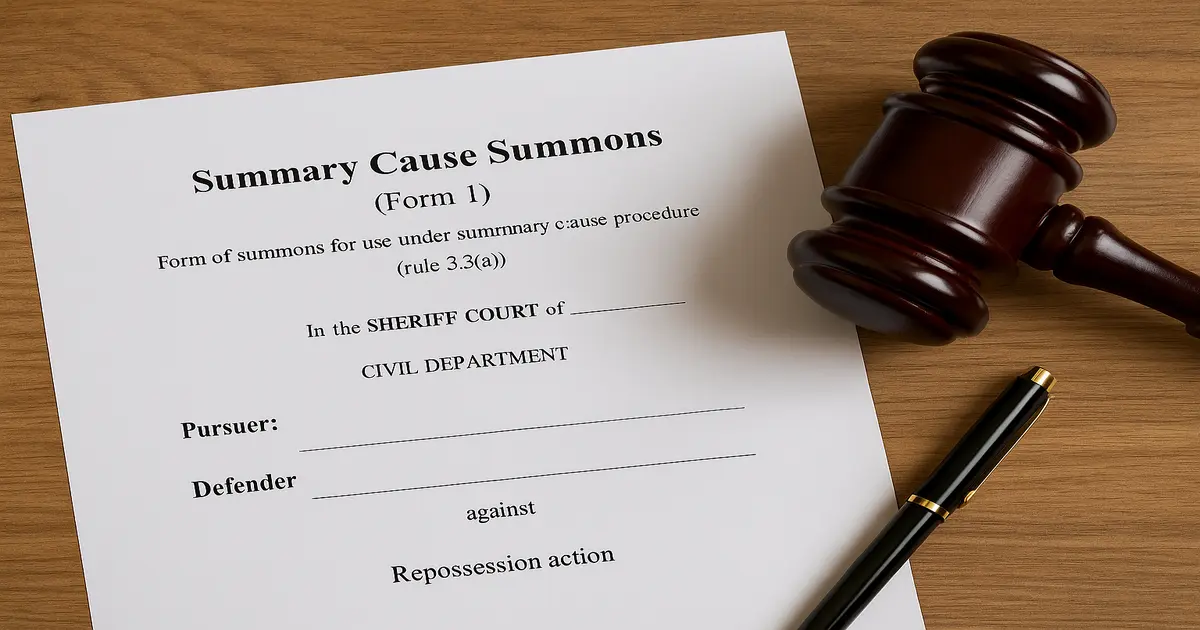
Summary Cause Summons (Form 1)
The Summary Cause Summons (Form 1) is the formal court document used in Scotland to initiate proceedings in the Sheriff’s Court under the Summary Cause Rules. This process is designed for specific types of civil claims where the claim value does not exceed a statutory cap.
In the context of repossession actions, landlords often use the summary cause procedure to seek a decree of removal (eviction) for commercial property when the claim falls within the value limit.
Purpose of the Summary Cause Summons
The Summons (Form 1) is the starting point for raising a summary cause action in the Sheriff’s Court. It sets out:
- The parties to the action (pursuer and defender)
- The basis of the claim (e.g. lease breach, non-payment of rent, valid termination notice)
- The orders sought (such as a decree of removal and expenses)
For repossession, the Summons tells the court and the tenant why the landlord believes they have the right to recover possession of the property.
Summary Cause, Procedure, and Value Cap
The Summary Cause procedure is designed for civil claims in Scotland with a value below a statutory monetary threshold (currently £5,000 for most claims, although this can vary).
This cap can affect whether landlords can use summary cause for rent arrears recovery if the amount exceeds the limit.
However, for repossession, the key is not the value of arrears alone but the nature of the remedy (recovering possession). Many commercial landlords use summary cause because it’s faster and simpler than the ordinary cause procedure for lower-value cases.
Used in the Sheriff’s Court
All summary cause actions are heard in the Sheriff’s Court. There is no separate tribunal for the repossession of commercial property.
When a landlord wants to evict a tenant using summary cause, they lodge the completed Form 1 (Summons) with the Sheriff Clerk, pay the applicable court fee, and arrange for service of the summons on the tenant.
The tenant then has the opportunity to respond (lodge a defence) within the specified time. If defended, the court will fix a hearing to consider both sides’ evidence and arguments.
If the court is satisfied the landlord has met the legal requirements—such as serving a valid Notice to Quit or Notice of Irritancy—it may grant a decree of removal, authorising eviction.
Form 1 (Summary Cause Rules)
Form 1 is the prescribed format under the Summary Cause Rules of Court. It ensures all essential information is included and that both the court and the tenant are informed about:
- Who is suing and who is being sued
- The legal grounds for the claim
- The remedies sought
- The basis of jurisdiction
While standardised in format, landlords must still ensure the Summons accurately reflects the lease terms, the service of notices, and the legal grounds for eviction.
Service of the Summons
After the landlord lodges the Summons with the Sheriff’s Court, it must be served on the tenant. Typically, this is done by a sheriff’s office service, ensuring the tenant receives formal notice and a copy of the claim.
Sheriff officers provide a certificate of service, which can be used in court to prove the tenant was notified correctly.
Proper service is essential. If the landlord fails to serve the Summons correctly, the action may be dismissed or delayed.
Enforcement Through Decree of Removal
Suppose the Sheriff Court grants a decree of removal. In that case, the landlord can instruct sheriff’s officers to serve a notice to remove the tenant, giving them a final period (usually 14 days) to vacate the premises.
If the tenant still refuses to leave, sheriff officers can carry out the eviction under the authority of the decree.
Not for Residential Tenancies
It is important to note that residential landlords do not use Summary Cause Summons (Form 1) for standard repossession claims. Residential evictions in Scotland are dealt with by the First-tier Tribunal (Housing and Property Chamber), which applies rent rules and forms.
Summary cause procedure and Form 1 are used for commercial leases (or other civil claims) in the Sheriff’s Court.
Importance of Legal Advice
Although Form 1 provides a standard structure, landlords need legal advice to:
- Confirm that the summary cause procedure is appropriate (given the value cap)
- Ensure notices to quit or irritancy notices were served correctly
- Draft clear, accurate grounds for repossession
- Handle defended actions in court
Tenants facing a Summons should also seek legal help promptly to understand their rights and options for defence.
Conclusion
The Summary Cause Summons (Form 1) is a crucial document for commercial landlords in Scotland seeking to repossess property through the Sheriff Court. It provides a standardised method to set out the claim and begin court proceedings under the Summary Cause Rules.
However, it is not simply a formality. Landlords must ensure they have served valid termination notices, respected all lease terms and statutory requirements, and followed proper service procedures. Errors can lead to dismissal or delays.
Understanding the summary cause process, the value cap, and the Sheriff Court’s role is vital for both landlords and tenants in managing commercial lease disputes.
FAQs
What is a Summary Cause Summons (Form 1)?
It is the formal document used to raise a summary cause action in the Sheriff’s Court, including claims for repossession of commercial premises.
When is the Summary Cause procedure used?
For civil claims where the value does not exceed the statutory limit (usually £5,000), including many commercial repossession actions.
Is Form 1 used for residential evictions?
No. Residential repossession cases are handled through separate procedures in the Housing and Property Chamber, rather than the Sheriff’s Court.
Who serves the Summons on the tenant?
Typically, a sheriff officer serves the Summons to ensure proper legal notice.
What happens if the tenant disputes the claim?
The tenant can lodge defences with the Sheriff’s Court, which will then fix a hearing to resolve the dispute.
What is a decree of removal?
A court order authorising eviction. Once granted, sheriff officers can enforce it to remove the tenant from the premises.
Do landlords need legal advice?
While not mandatory, legal advice is strongly recommended to ensure the Summons is an accurate, valid notice that has been served and that the correct procedure is followed.
Can a landlord recover unpaid rent in the same action?
If the amount of arrears is within the value cap, landlords can include a claim for payment alongside the repossession request in the Summons.
Useful External Links
Scottish Courts and Tribunals Service – Summary Cause Guidance
https://www.scotcourts.gov.uk/taking-action/civil-court-cases/summary-causeScottish Courts and Tribunals Service – Sheriff Court
https://www.scotcourts.gov.uk/the-courts/sheriff-courtSummary Cause Rules of Court (Scottish Statutory Instrument)
https://www.legislation.gov.uk/ssi/2002/132/contents/madeLaw Society of Scotland – Find a Solicitor
https://www.lawscot.org.uk/find-a-solicitor/The British Landlords Association is a national association for landlords in the UK. It is one of the most significant landlord associations in the UK. Join us now for £89.95!
Our top-read blogs:
Investing in Commercial Property vs Residential Property: The Advantages and Disadvantages
Commercial Property Landlord Association-The Bla