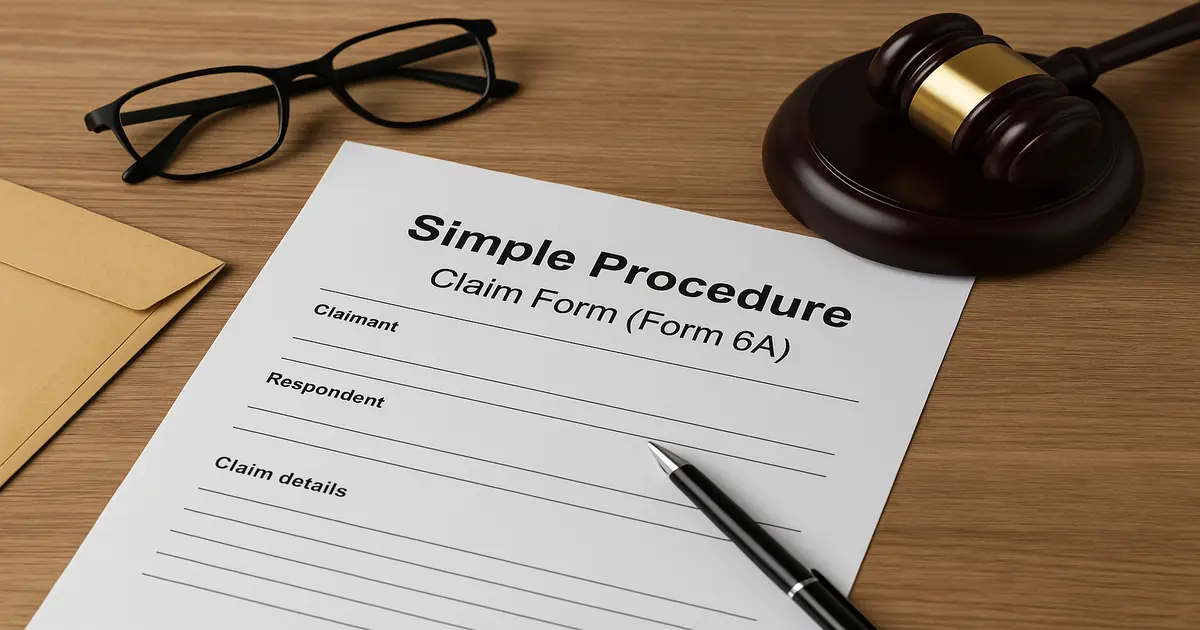
Simple Procedure Claim Form (Form 6A)
The Simple Procedure Claim Form (Form 6A) is the standard court document used in Scotland to start a simple procedure case in the Sheriff Court. The simple procedure is a streamlined civil court process designed for resolving certain types of claims of £5,000 or less.
It replaces the old small claims system and aims to make court action more accessible and less formal.
Purpose of Form 6A
Form 6A is used to initiate a simple procedure case in the Sheriff’s Court. It sets out the details of:
- The claimant (known as the “claimant” or “pursuer” in Scotland)
- The respondent (the “defender”)
- The nature of the claim (e.g. unpaid debt, breach of contract, repossession)
- The remedy sought (payment, delivery, repossession, etc.)
In eviction cases, landlords use Form 6A to seek an order for possession of property where the value of the claim, including arrears, falls within the £5,000 limit and other criteria are met.
For Debts or Eviction Under £5000
The simple procedure can only be used for claims valued at £5,000 or less. This includes:
- Debt recovery actions (unpaid rent, services, or goods)
- Eviction for unpaid rent (where arrears are below the threshold and tenancy criteria are met)
For landlords, it can be a cost-effective way to recover small rent arrears or regain possession when statutory criteria permit.
However, landlords must ensure their case qualifies for a simple procedure. If the sum owed exceeds £5,000, or if the tenancy type is excluded, they must use other procedures such as summary cause or ordinary cause.
Eviction Can Be Pursued If Criteria Are Met
For eviction using a simple procedure, the landlord must show:
- They have served all required notices (e.g. Notice to Quit, pre-irritancy notice if commercial)
- The tenancy type is eligible (the simple procedure is typically used for certain residential tenancies, though commercial landlords sometimes use it for low-value rent debts without seeking repossession)
- The value of the claim—including any arrears—is within the £5,000 cap.
If these conditions are not met, the court may refuse jurisdiction, and the landlord will have to use another process.
Sheriff Court Form
Form 6A is a Sheriff Court form governed by the Simple Procedure Rules. It must be completed carefully and accurately, including:
- Names and addresses of parties
- Court details (Sheriffdom and Sheriff Court)
- A clear, concise statement of the facts and legal basis for the claim
- Evidence or references to supporting documents
Once completed, the form is lodged with the Sheriff Clerk and served on the respondent (typically by a sheriff officer or recorded delivery).
Simpler, More Accessible Process
The simple procedure is designed to be more user-friendly than older court processes. It uses:
- Plain English forms
- Electronic submission options in many courts
- Informal case management discussions
- Flexibility to resolve disputes without a formal proof (trial)
The aim is to help non-lawyers understand and use the process, although many still choose to instruct solicitors for eviction or debt cases.
Service of Form 6A
Once the claim is registered with the court, it must be served on the respondent. This can be done by:
- Sheriff officers (for formal personal service)
- Recorded delivery (where accepted)
Proper service is essential, as the court will not consider the claim until the respondent has been given a fair opportunity to respond.
Enforcement of Court Orders
If the Sheriff grants a decree (judgment), the landlord can then enforce it. For eviction, sheriff officers carry out the physical eviction under the authority of the decree.
For debts, enforcement options include arrestment (freezing bank accounts), earnings arrestment (deductions from wages), or seizure of assets.
Not for High-Value or Complex Cases
The simple procedure is not suitable for:
- Claims over £5,000
- Highly complex disputes requiring extensive evidence
- Certain tenancy types are excluded by statute
For these, landlords must use summary cause or ordinary cause procedures.
Importance of Legal Advice
Although designed to be user-friendly, the procedure still requires careful compliance with rules. Mistakes in completing or serving Form 6A can delay or derail a claim.
Landlords should consider legal Advice to:
- Confirm eligibility for a simple procedure
- Ensure all pre-action requirements (such as serving notices) are met
- Draft clear and persuasive claim statements
- Manage defended actions in court
Tenants facing a simple procedure eviction claim should also seek Advice promptly to understand their rights, prepare defences, and explore settlement options.
Conclusion
The Simple Procedure Claim Form (Form 6A) is an essential tool for landlords and creditors seeking to recover debts or evict tenants where the total value of the claim is £5,000 or less.
Used in the Sheriff Court under the Simple Procedure Rules, Form 6A provides a clear, standardised way to present the claim. However, landlords must ensure they meet all statutory requirements, serve the form properly, and prepare for possible court hearings.
For both landlords and tenants, understanding the simple procedure is crucial to ensuring rights are protected and disputes are resolved fairly and efficiently.
FAQs
What is Form 6A?
Form 6A is the standard claim form for raising a simple procedure action in the Sheriff’s Court in Scotland.
When is a simple procedure used?
For claims worth £5,000 or less, including debt recovery and eligible eviction actions.
Can landlords use simple procedures for eviction?
Yes, if the tenancy type is eligible and the arrears or value of the claim is within the £5,000 limit.
Is Form 6A for commercial or residential evictions?
It is primarily used for residential evictions within the value cap, but can sometimes be used for low-value commercial debt claims (though not usually for commercial repossession itself).
Who serves Form 6A on the tenant?
Typically, sheriff officers or by recorded delivery if permitted.
What happens if the tenant defends the claim?
The Sheriff’s Court will fix a case management discussion and, if needed, a hearing to decide the dispute.
Can landlords enforce decrees granted under the simple procedure?
Yes. For eviction, sheriff officers carry out the eviction. For debts, arrestments and other diligence can be used.
Is legal Advice necessary?
While the simple procedure is designed to be user-friendly, legal Advice is strongly recommended to avoid errors and maximise the chance of success.
Useful External Links
- Scottish Courts and Tribunals Service – Simple Procedure Guidance
- https://www.scotcourts.gov.uk/taking-action/simple-procedure
- Scottish Courts and Tribunals Service – Sheriff Court
- https://www.scotcourts.gov.uk/the-courts/sheriff-court
- Simple Procedure Rules of Court (Scottish Statutory Instrument)
- https://www.legislation.gov.uk/ssi/2016/200/contents/made
- Scottish Legal Aid Board
- https://www.slab.org.uk/
- Law Society of Scotland – Find a Solicitor
- https://www.lawscot.org.uk/find-a-solicitor/
- Citizens Advice Scotland – Help with Debts and Evictions
- https://www.citizensadvice.org.uk/scotland/
- Faculty of Advocates – Specialist Legal Representation
- https://www.advocates.org.uk/
These resources will help you understand the Simple Procedure process, access rules and forms, and find legal support for managing debt recovery and eviction claims in Scotland.
The British Landlords Association is a national landlords association for UK landlords. It is one of the largest landlord associations in the UK. Join us now for £89.95!
Our top read blogs:
Investing in Commercial Property vs Residential Property: The Advantages and Disadvantages
Commercial Property Landlord Association-The Bla