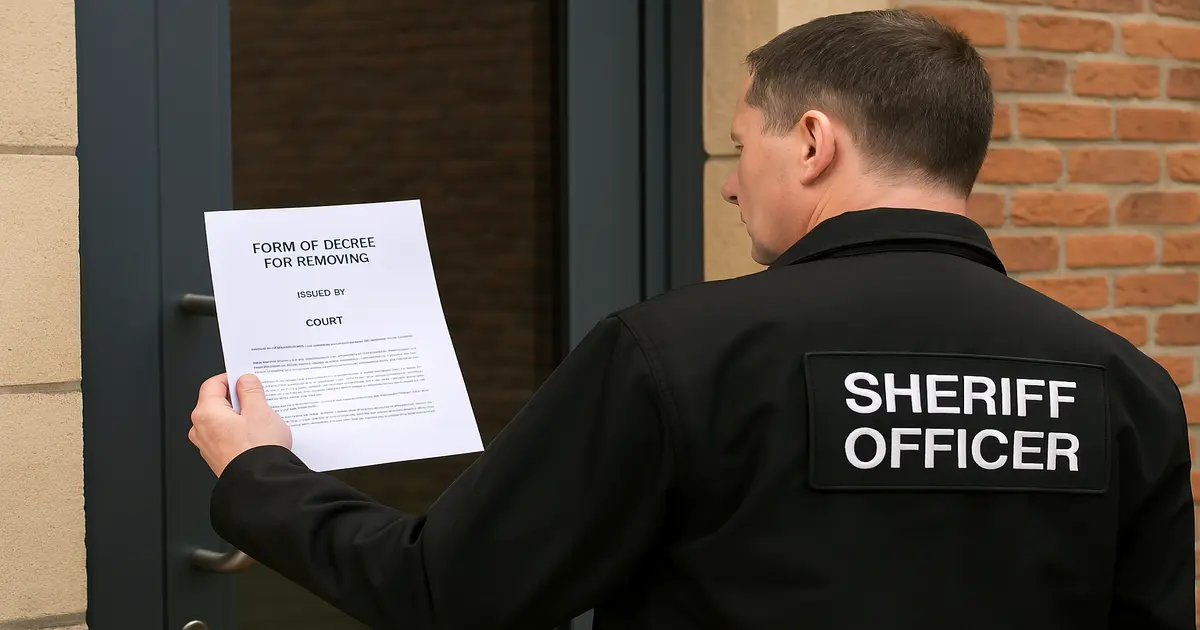
A Complete Guide to Sheriff Court Eviction Procedures
Commercial landlords in Scotland cannot evict tenants by force or threat without due legal process. Eviction from commercial premises is a formal court process governed by the Sheriff’s Court. One of the central legal instruments in this process is the Form of Decree for Removal.
This document authorises the physical removal of tenants from leased commercial property when they fail to leave voluntarily after the lease ends or is terminated.
This article provides a detailed explanation of what a decree for removal is, how it is obtained, and how Sheriff Officers enforce it. We also discuss legal safeguards for tenants, procedural requirements for landlords, and best practices for enforcing commercial leases in Scotland.
Understanding Commercial Lease Termination
Commercial leases in Scotland are primarily governed by contract law. Unlike residential tenancies, which have dedicated statutory protections and tribunals, commercial leases rely on the courts to enforce terms. Termination of a commercial lease can arise from:
- Expiry of the lease term
- Mutual agreement (surrender)
- Irritancy (breach of lease conditions)
- Non-payment of rent
If the tenant refuses to vacate after termination, the landlord must obtain a court order—the decree for removal.
What Is a Decree for Removing?
A decree for removal is an official court judgment granted by the Sheriff Court. It formally authorises the eviction of a tenant from commercial premises. It serves as the legal basis for a Sheriff Officer to carry out an eviction.
Key points about the decree for removing:
- It is a civil court order specific to Scots law
- It cannot be obtained without due process
- It provides authority for physical removal by a Sheriff Officer
- It protects landlords from accusations of unlawful eviction
The decree is essential because landlords cannot lawfully remove tenants themselves or use intimidation or force.
Sheriff Court Jurisdiction Over Commercial Evictions
In Scotland, commercial evictions are handled exclusively by the Sheriff Court, not the First-tier Tribunal (Housing and Property Chamber). This distinction exists because the tribunal’s remit is residential tenancies.
The Sheriff Court has the power to:
- Decide if the lease termination is valid
- Assess whether notice to quit or irritancy procedures were followed
- Grant decree for removing if appropriate
Landlords must prove their case in court before any eviction can take place.
How to Obtain a Decree for Removing
To obtain a decree for removal, the landlord must raise an action in the Sheriff’s Court using the appropriate procedure. Typically, this is the Ordinary Cause procedure for complex or high-value cases, though simpler procedures may apply in lower-value disputes.
Key steps include:
- Preparing and lodging an Initial Writ
- Serving the writ on the tenant
- Allowing the tenant to respond or defend
- Attending procedural hearings
- Presenting evidence at proof (trial) if needed
If the Sheriff is satisfied that the lease was validly terminated and the notice requirements were met, they may grant a decree for removal.
Importance of Serving Notice to Quit
A decree for removal will not be granted if the landlord fails to serve a valid Notice to Quit. Although no statutory form exists for commercial leases, notice must comply with:
- Lease terms
- Common law requirements
- Reasonable notice periods
Service must be formal, typically by recorded delivery or Sheriff Officer. Errors in notice can derail eviction proceedings.
Irritancy as a Ground for Termination
A frequent ground for seeking a decree for removal is irritancy, which is the landlord’s contractual right to terminate the lease for breach (often non-payment of rent). Under Scots law:
- The landlord must serve an irritancy notice
- The tenant must be given any contractual “period of grace.”
- Compliance with statutory safeguards (e.g., Law Reform (Miscellaneous Provisions) (Scotland) Act 1985) is required
Failure to comply can invalidate the irritancy and block the eviction.
Tenant Defences in Sheriff’s Court
Tenants have a right to defend an action for removal. Common defences include:
- Disputing the lease’s termination
- Alleging invalid or defective notice
- Challenging calculation of arrears
- Asserting waiver of a breach by the landlord
The Sheriff will consider these defences before deciding to grant a decree.
Content of the Decree for Removing
The decree itself is a formal document issued by the court. It will typically:
- Identify the parties and premises
- Confirm the basis for removal (e.g., expiry, irritancy)
- Order the tenant to vacate by a set date
- Authorise a Sheriff Officer to enforce removal if necessary
The decree serves as a legal warrant for the Sheriff’s Officer to enter the property and remove the tenant and their possessions.
Enforcement by Sheriff’s Officer
Once a decree for removal is granted, landlords cannot simply take possession themselves. Enforcement must be carried out by a licensed Sheriff Officer. Steps include:
- Serving formal notice of removal (typically 14 days)
- Allowing time for voluntary vacation
- Attending the premises on the appointed day
- Using lawful means to remove occupants and goods
- Securing the property for the landlord
Sheriff Officers have the authority of the court behind them and ensure the process is orderly, safe, and lawful.
Notice of Removal Requirements
Before enforcing a decree, a Sheriff Officer must serve a Notice of Removal. This is a legal requirement in Scots law, ensuring that tenants receive clear advance notice of eviction.
Features include:
- Stated date and time of removal
- Minimum statutory notice period (usually 14 days)
- Formal service to the tenant
Failure to serve a valid notice can render the eviction unlawful.
Avoiding Self-Help Eviction
Scottish law prohibits landlords from evicting tenants without a court order. Unlawful eviction can lead to:
- Criminal liability under the Rent (Scotland) Act 1984 (for residential tenancies, often a caution for mixed-use or residential over commercial)
- Civil damages claims
- Reputational harm
Even though commercial leases do not have the same statutory eviction protections as residential tenancies, due process must still be followed.
Role of Solicitors in Obtaining Decree
Because Sheriff Court procedure is formal and complex, landlords generally instruct solicitors to:
- Draft and lodge the Initial Writ
- Ensure correct service of documents
- Present the case in court
- Prepare for proof if needed
- Advise on costs and enforcement
Proper legal advice reduces the risk of dismissal or delay.
Costs of Sheriff Court Proceedings
Litigating to obtain a decree for removing involves costs:
- Solicitor fees
- Sheriff Officer fees for service and enforcement
- Court dues
While successful landlords can request that the court award expenses against the tenant, full recovery is not guaranteed.
Alternatives to Litigation
Landlords and tenants often choose to avoid court by negotiating:
- Surrender agreements
- Repayment plans for arrears
- Voluntary vacation dates
Early negotiation can avoid the need for a decree for removing altogether, saving time and expense.
Best Practice for Landlords
Commercial landlords should:
- Review lease terms before action
- Serve valid Notice to Quit or irritancy notices
- Document breaches and payment history
- Seek legal advice early
- Communicate with tenants to explore settlement
These steps reduce the risk of failed court actions and improve enforcement success.
Useful External Links
For further guidance on Scottish eviction law and Sheriff Court procedure, see:
- Scottish Courts and Tribunals Service: www.scotcourts.gov.uk
- Law Society of Scotland: www.lawscot.org.uk
- Faculty of Advocates: www.advocates.org.uk
- Citizens Advice Scotland (for tenants): www.citizensadvice.org.uk/scotland
- Scottish Government Justice: www.gov.scot/policies/justice
Frequently Asked Questions
What is a decree for removing?
A decree for removing is a court order from the Sheriff Court authorising the eviction of a tenant from commercial premises. It is essential for lawful removal.
How does a landlord get a decree for removal?
By raising an action in the Sheriff’s Court, serving proper notices, and proving grounds for termination. The court must be satisfied before granting the decree.
Can a landlord evict without a decree?
No. Self-help eviction is unlawful. Only a Sheriff Officer acting under a valid decree can remove a tenant.
What is a Notice of Removal?
A formal notice is served by a Sheriff Officer after the decree is granted, giving the tenant a warning of the eviction date.
How long does the eviction process take?
Timing varies. It includes notice periods, court scheduling, potential tenant defences, and the required notice of removal before enforcement.
Can costs be recovered from the tenant?
Possibly. The Sheriff Court can award expenses against the tenant, but full recovery is not guaranteed.
Is legal representation required?
It is not legally required but strongly recommended due to the complexity of court procedures and the risk of errors.
Are there alternatives to court?
Yes. Negotiated surrender, repayment agreements, and mediation can resolve disputes without litigation.
What happens on eviction day?
A Sheriff Officer attends the premises, ensures lawful removal of the tenant and goods, and secures the property for the landlord.
Why is the decree for removing important?
It ensures eviction is lawful, protects both parties’ rights, and enables professional enforcement by Sheriff Officers.
This comprehensive guide explains how the decree for removal operates within Scotland’s Sheriff Court system to ensure lawful commercial evictions, balancing landlords’ rights to recover premises with tenants’ protections against unlawful eviction.
The British Landlords Association is a national landlord association for UK landlords and one of the largest landlord associations in the UK. The BLA is the only commercial landlords association in the UK. Join us now for £89.95!
Our top read blogs:
Is Commercial Property a Good Investment in England & Wales?
Commercial Property Rent Review Protocol
Investing in Commercial Property vs Residential Property: The Advantages and Disadvantages